.jpg)
Target at Erkner, Berlin.Taken on 8th March 1944 mission, from B-17 #42-37801. Photo courtesy of www.384thbombgroup.com
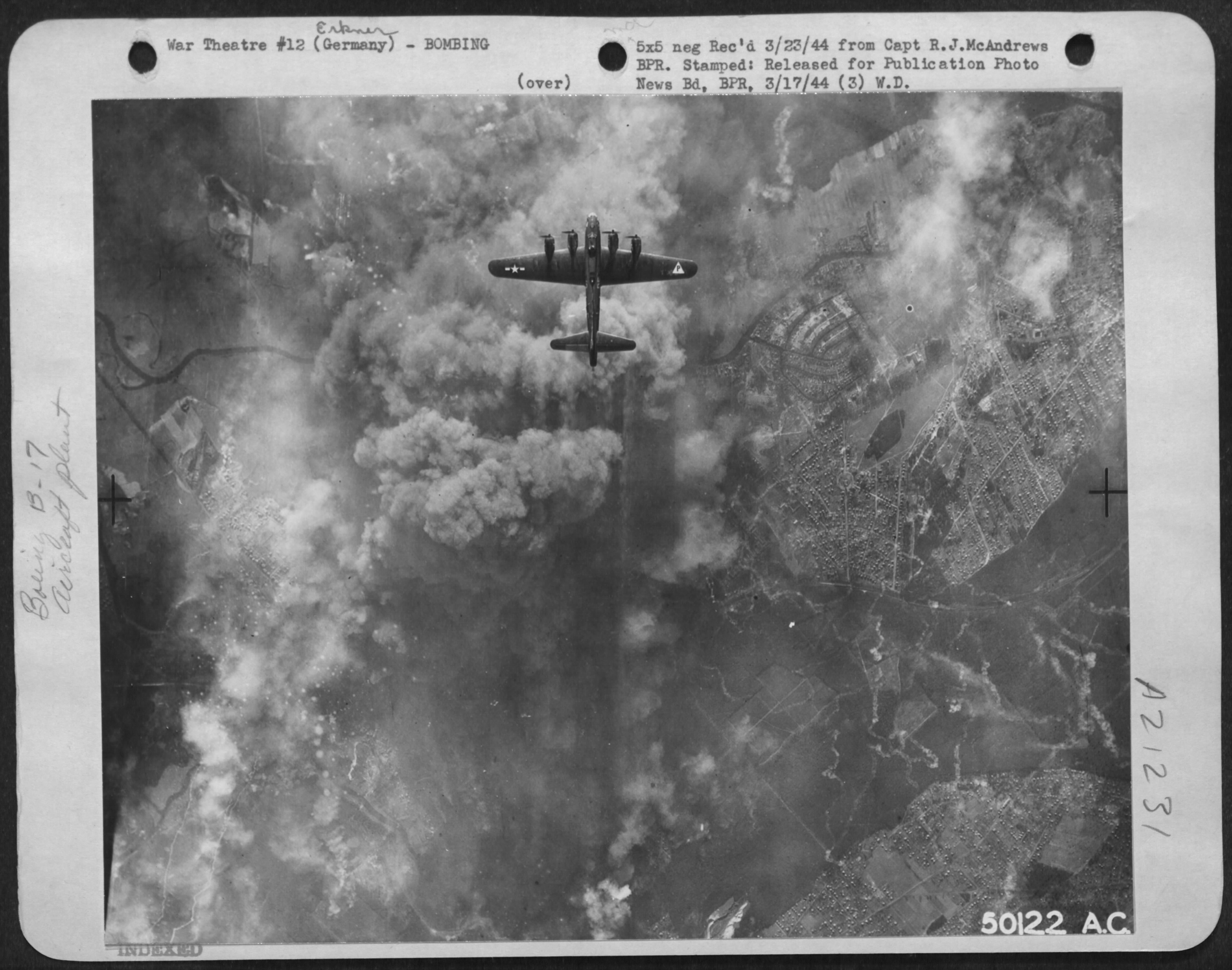
Target VKF Aircraft Bearings Plant, Erkner - 15 miles SE of Berlin city centre. 8th March 1944. The aircraft in the image may be Mairsy Doats. Photo courtesy of www.384thbombgroup.com
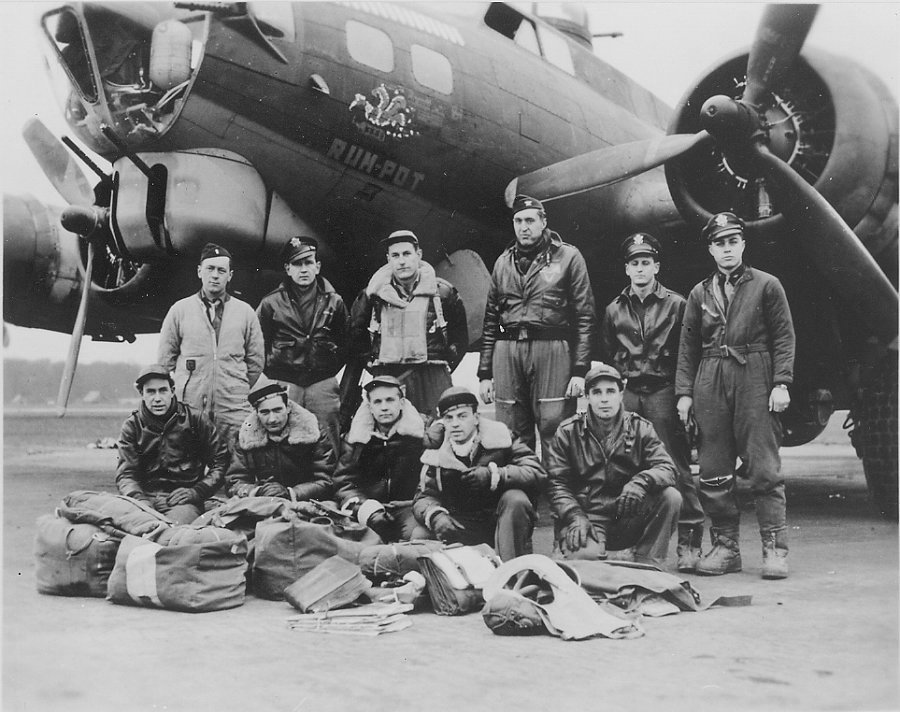
Wing Lead crew - 1st Lt. Stearns with B-17 #42-31433 Rum Pot II. C/O Dale Smith visible in the shot, having flown with the crew on this mission. Photo courtesy of www.384thbombgroup.com
.jpg)
Mission of 9th March 1944, secondary target attacked - Berlin city centre. Visible in image - #42-31346 Shack Rabbit, #42-97477 Porky's Pig, #42-31484 Mairsy Doats.
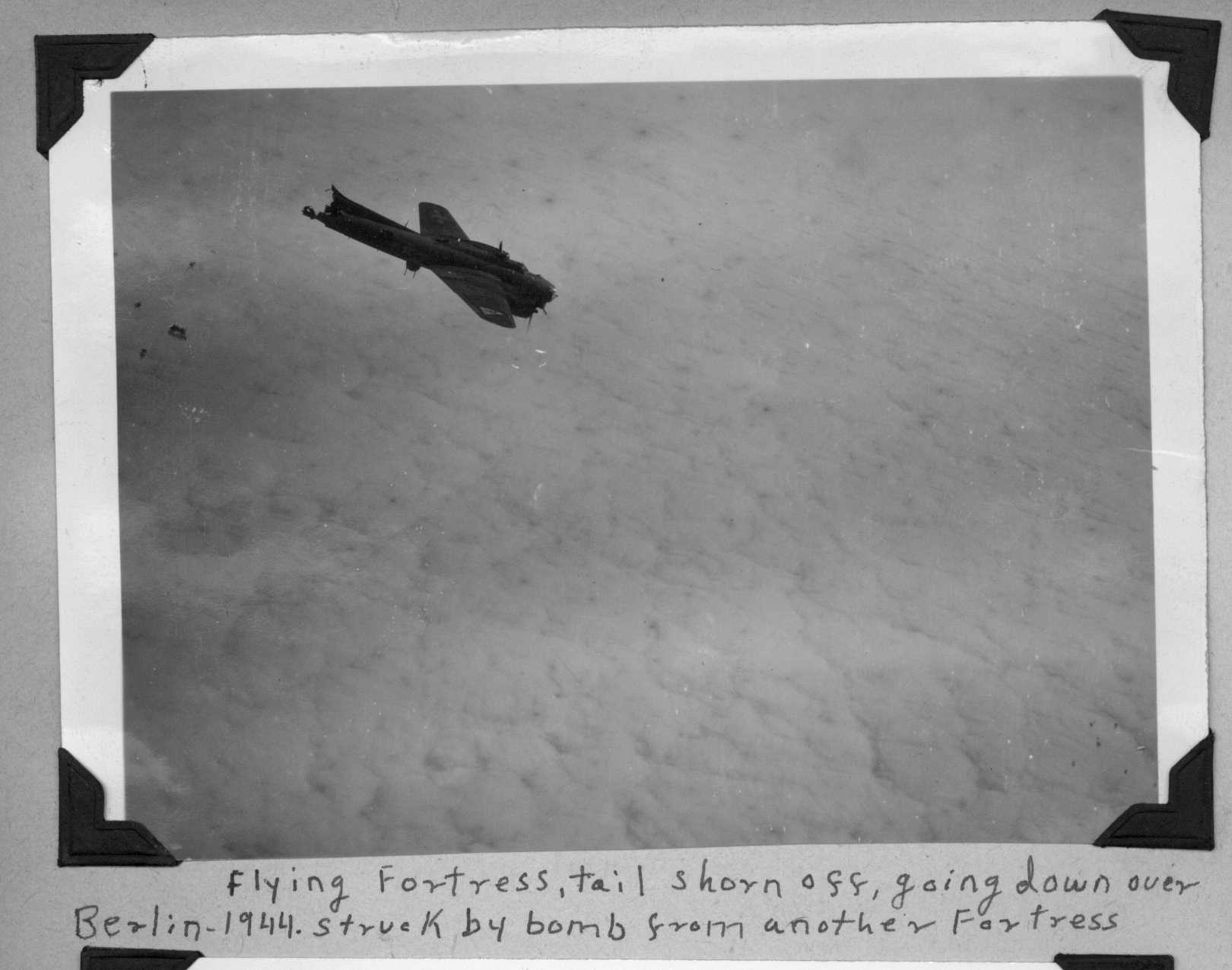
9th March 1944 - the demise of B-17G #42-37781 Silver Dollar. The tail assembly had been destroyed by falling bombs - 8 crew KIA, 2 POW's. Photo Robert Bletscher, courtesy of www.384thbombgroup.com
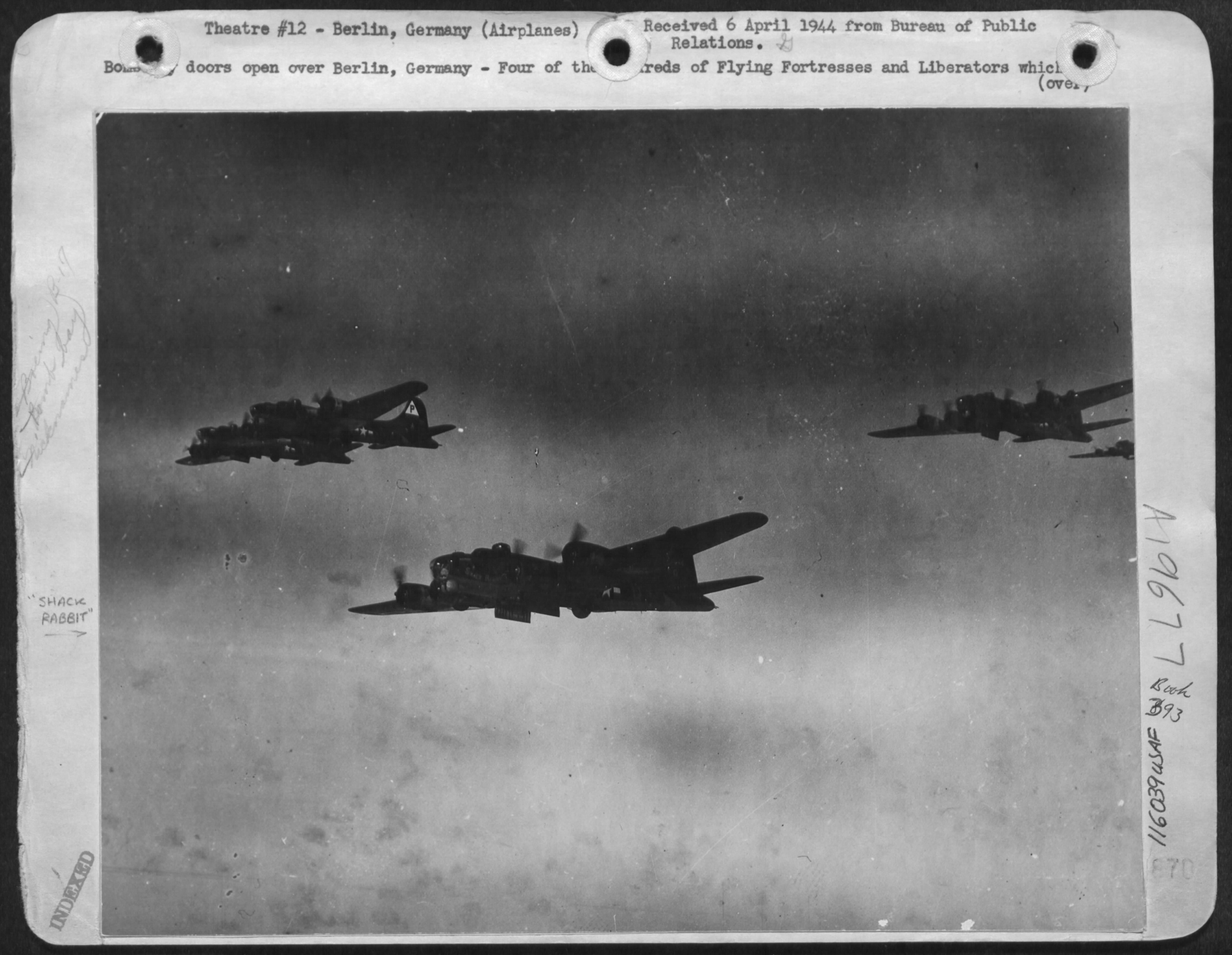
9th March 1944 - B-17G #42-31346 Shack Rabbit approaching the target area. Photo Mark Meehl, courtesy of www.384thbombgroup.com
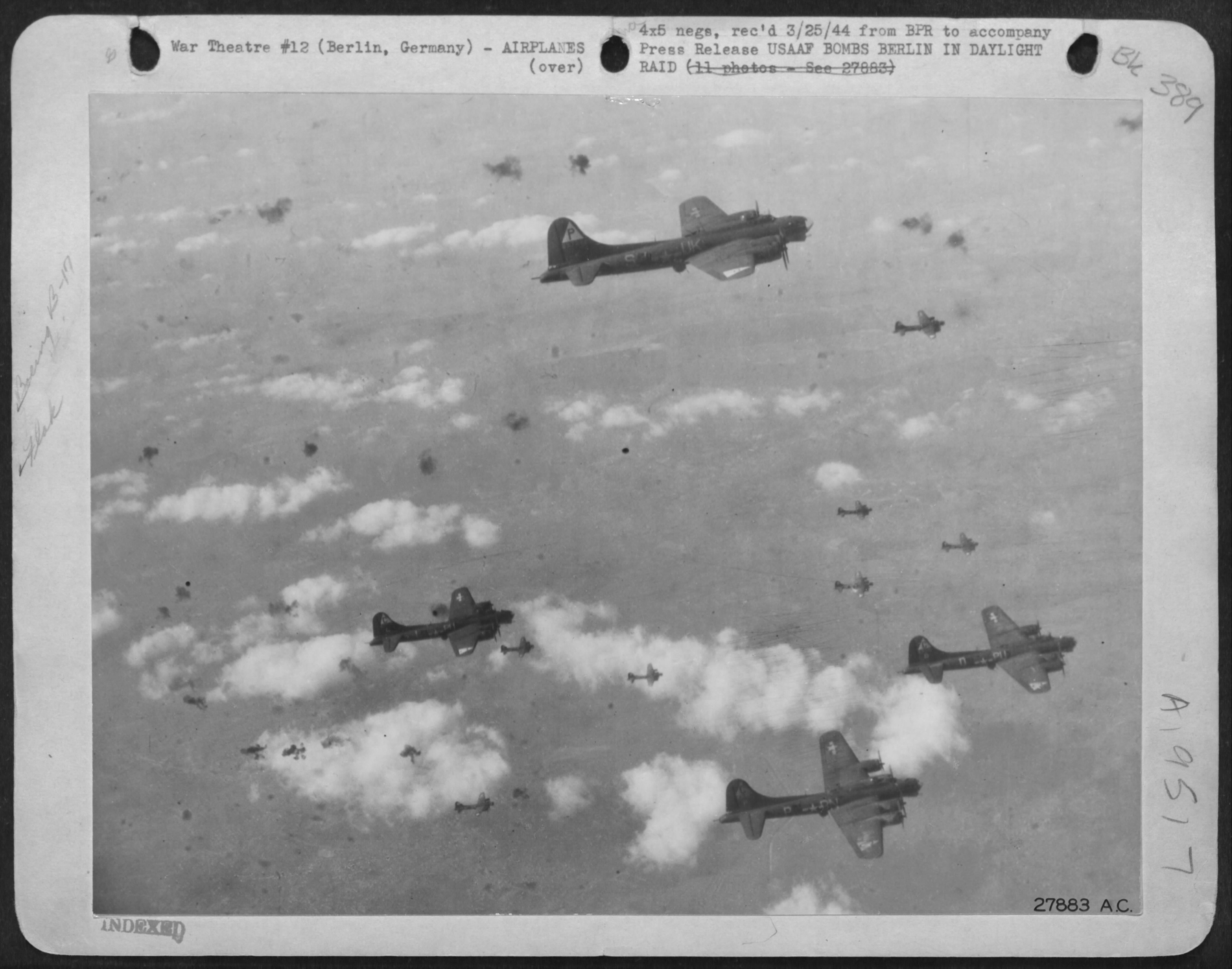
384th BG B-17's flying alongside those of the 303rd BG, RAF Molesworth. Photo courtesy of www.384thbombgroup.com
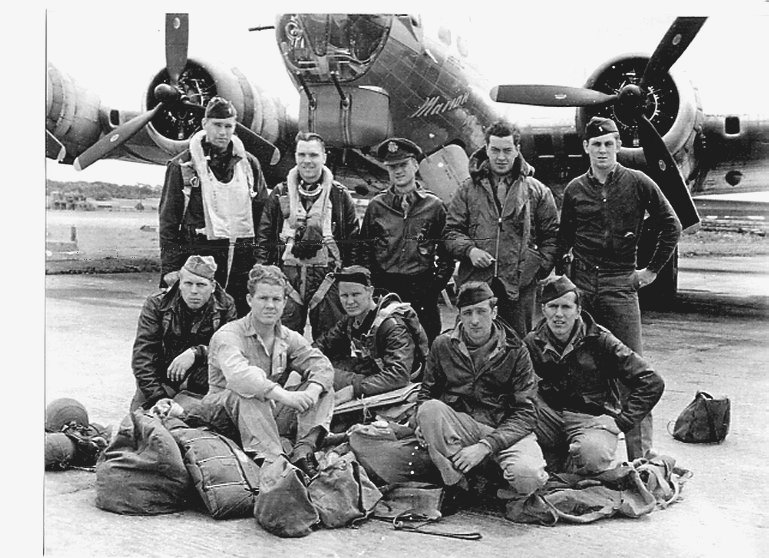
21st June 1944, Low Group Lead crew. Pilot 2nd Lt. Dewayne Bennett, aircraft B-17G #42-97941 Marion. Photo courtesy of www.384thbombgroup.com
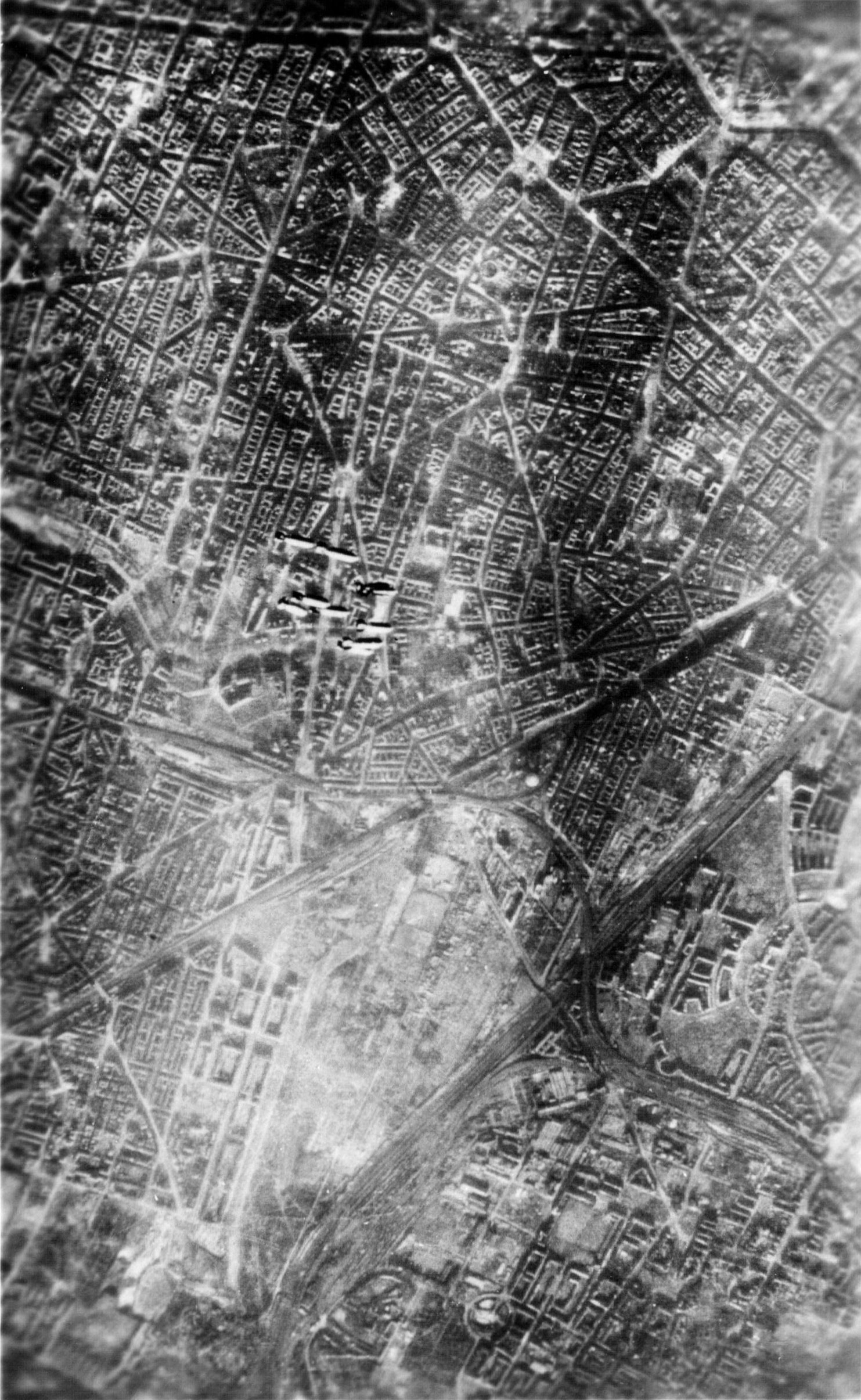
3rd February 1945 - Schoneberg area of Berlin. Target image of (assumed) Tempelhof Marshalling Yards, Berlin. Photo courtesy of www.384thbombgroup.com
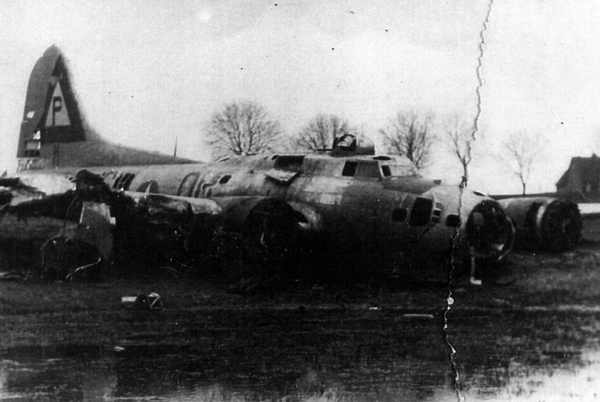
3rd February 1945. B-17G #42-97960, pilot Lt. Charles R. Molder. Crashed near the village of Fuersten Werder, Prenblau - north of Berlin. All crew POW's. Photo Wilhelm Zimmermann, courtesy of www.384thbombgroup.com
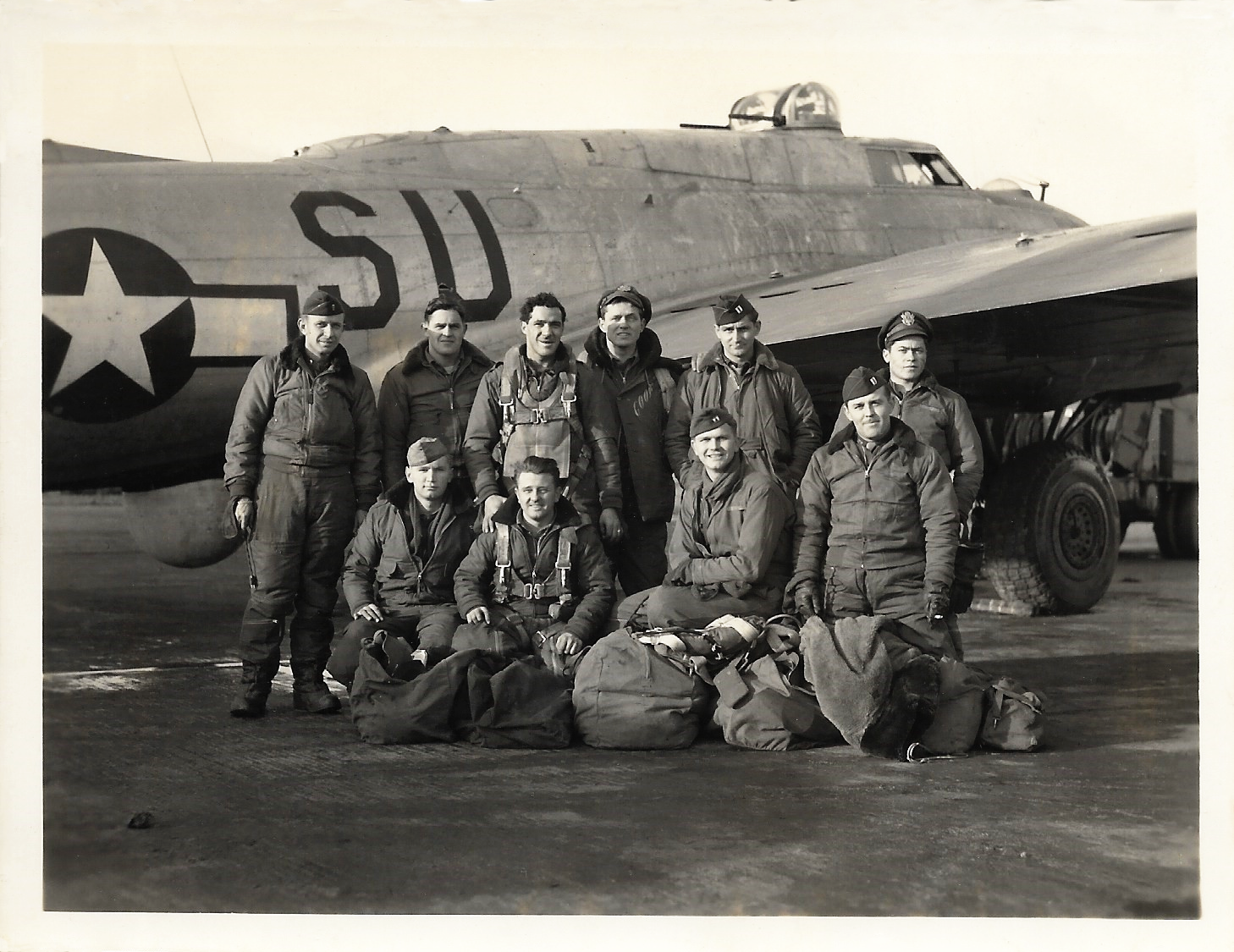
3rd February 1945 - Group Lead crew, pilot Capt. James Gilmore. Photo Cynthia Smith, courtesy of www.384thbombgroup.com
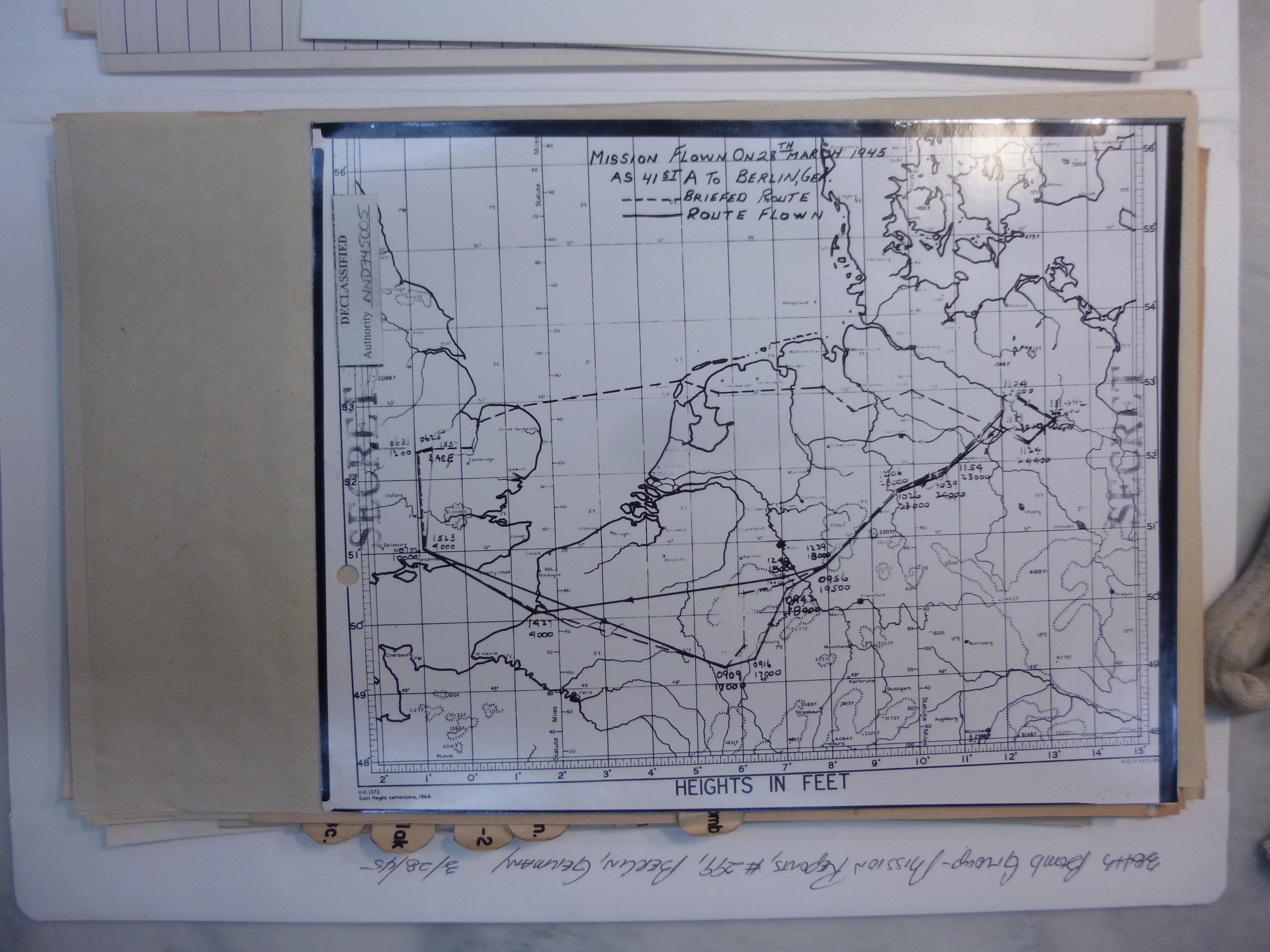
28th March 1945 - flight map to and from target at Berlin, Germany. Photo courtesy of www.384thbombgroup.com
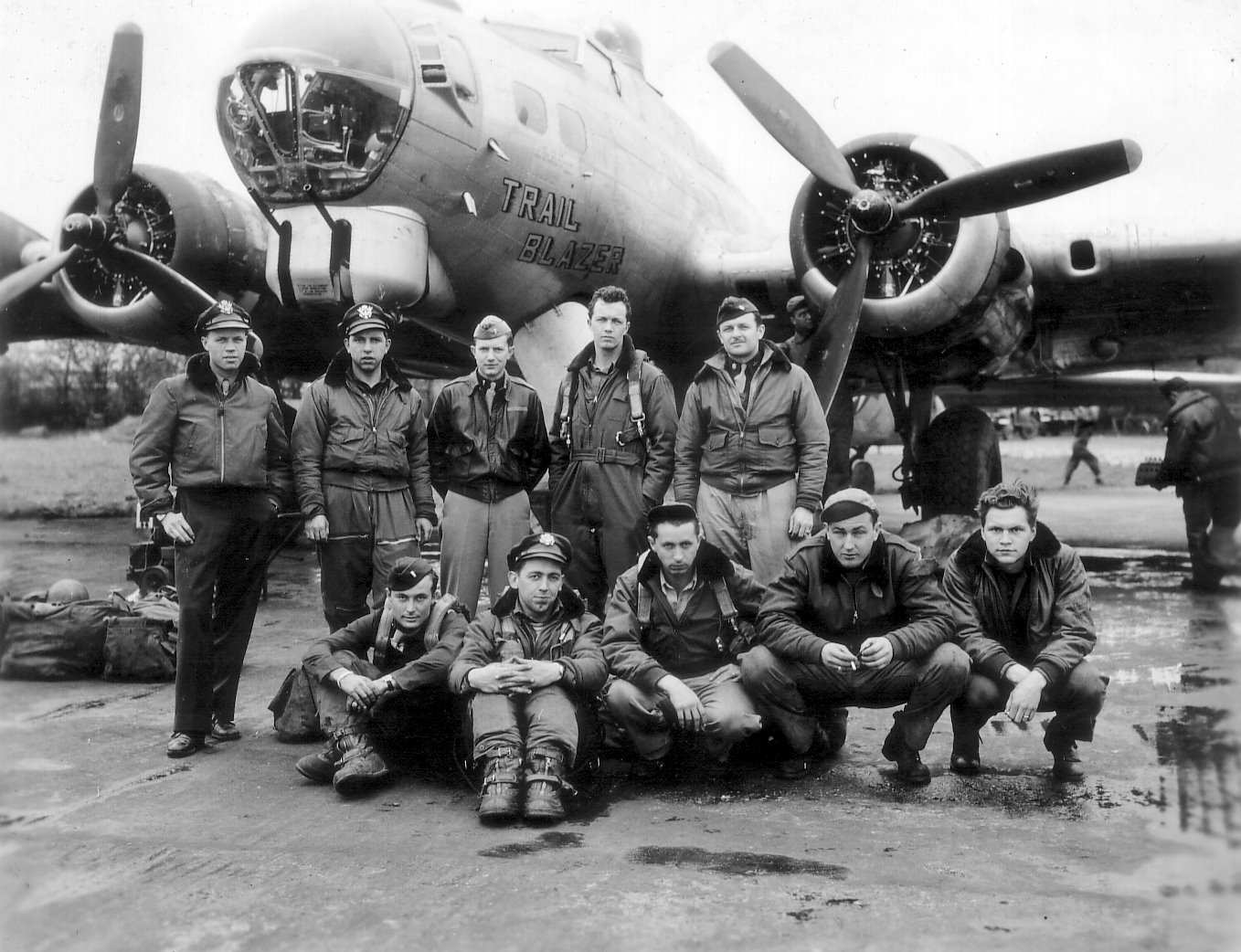
28th March 1945, mission to Berlin - Group Lead Crew. Pilot 2nd Lt. Raymond D. Cook. B-17G #44-8649 Trail Blazer. Photo courtesy of www.384thbombgroup.com
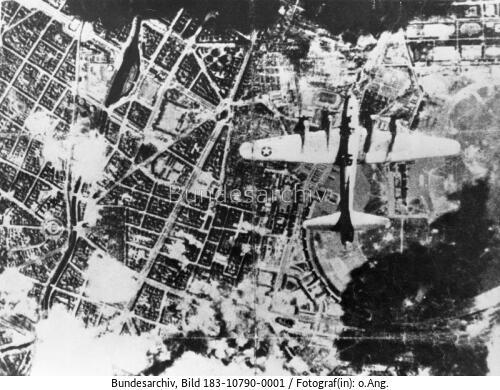
1945 - right wing of aircraft is over Tempelhof airfield. Left of image shows Mehringplatz. Photo courtesy of www.bundesarchiv.de
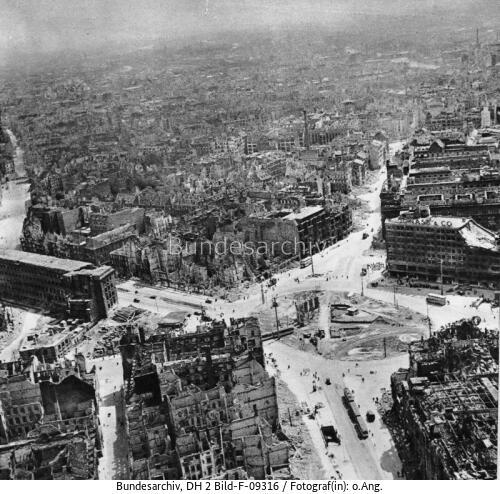
Showing the ruins of Alexanderplatz, Berlin towards the end of the war. Photo courtesy of www.bundesarchiv.de

Flakturm Humboldthain, located in Volkspark Humboldthain, Berlin - photograph taken in 2026. Photo courtesy of Charlie Saddington.
Bombing "Big B" - the 384th missions to Berlin
Among the most feared targets for air crews of the 384th was Berlin. For one, it was protected by a significant quantity of FLAK, and aircraft of the Luftwaffe, creating a very capable defensive force. Secondly, the distance meant that many operations were lengthy, often over 8 hours. Until the American 8th Air Force arrived, for much of the war Berlin had been beyond the capabilities of the Royal Air Force (RAF), who struggled with limited numbers of obsolescent aircraft. With the United States Army Air Force (USAAF) now joining the war effort, the Allied nations had the opportunity to inflict damage on Germany both day and night – the 8th Air Force by day, and the RAF by night.
The 384th Bomb Group would not attempt to strike Berlin until 3rd March 1944, the recalled Mission #70. It is apparent that the prospect of bombing “Big B” was used as a symbol of victory for airmen as much as it was hoped it would be a symbol of defeat for the enemy population. Though airmen in their diaries record that they feared Berlin for the FLAK, the Luftwaffe or for getting shot down and caught by the Gestapo or SS (as written by 2nd Lt. Mark Calnon), The Plane News attempted to buoy them. Since many were drafted, the Summer 1944 edition wrote that “bombs are dropped on Berlin by the clerk and the carpenter, the electrician and the telephone operator” in a bid to galvanise the servicemen. Similarly in the Spring 1945 edition, The Plane News discussed the 384th's contribution to the “relentless march on Berlin”. Other cities and regions (such as the Ruhr) were more industrial than Berlin, others hosted more military assets, yet Berlin endured in the British and American minds as the symbol that would bring Germany to its knees. In so doing, the cost of men and aircraft was high. The Luftwaffe defended Berlin likes bees do their nest, and the carpet of FLAK that greeted airmen was frequently thick and intense. Hitler ordered for three heavy FLAK towers to be placed in a triangular formation around Berlin in 1940, anticipating an Allied air offensive. One attached image is of the standing (though heavily graffitied) tower in Volkspark, Gesundbrunnen. Whilst they were equipped with several calibres of gun, including 88mm and 128mm FLAK guns, the towers could also act as air raid shelters for tens of thousands of civilians.
Berlin and nearby Oranienburg were targets because they had objectives that theorist General William Mitchell wrote of in 1925, including industrial districts, many railway yards (including at Tempelhof) and stations, military establishments, necessary means of communications, civilians, and of course the Nazi Government, and more. Other places situated close to Berlin, such as Oranienburg, were also targeted, meaning that should aircrews be unable to strike one, they may hit the other as a secondary target or Target of Opportunity (TOO), as seen on Missions #74 and #79. However, in the event that no other target could be identified, crews would be forced to return to Grafton Underwood and jettison their bomb loads in the North Sea, which S/Sgt. Philip William Chaperon begrudged due to the wastage of valuable resources. In total, the 384th attempted to fly 15 missions with Berlin the target, and 19 in total with Oranienburg, with 2 recalled entirely – Missions #70 and #100. Mission #71 was redirected from Berlin to the Rhine due to adverse weather, and a TOO was selected, originally believed to be Cologne but later confirmed as Bonn. The 384th bombed “Big B” on 14 occasions, and Oranienburg twice. In brief, 16 of the 19 missions culminated in a raid.
On 3rd March 1944, the 384th were listed to fly to Berlin for the first time. For Mission #70, 27 aircraft were assigned. All but the ground spare took off, but upon entering enemy air space the mission was recalled. Officially, this is because of low fuel as a result of aircraft manoeuvring due to poor weather. Yet at least 12 aircraft developed mechanical faults (5 had issues with superchargers), and others included oil issues, vibrations and carburettor issues. One aircraft was forced to land immediately after taking to the air, before rejoining the squadron later after the issue was resolved. The crew of this aircraft (2nd Lt. Charles Edgar Decker) and all other recalled crews received combat credit for their efforts. Despite the troubles, no aircraft or crew were lost, despite the ball turret gunner of 42-31166 Miss Billie Jr. (S/Sgt. Charles John Metz) being seriously wounded with frostbite to his left hand.
The following day and mission (Mission #71) saw 3 aircraft lost. Though Berlin was the target for the second subsequent day, this mission was altered due to weather. Instead, a non-military target in the Ruhr was the aim. However, upon arrival, the target was obscured by dense cloud, leading to the wing (partially comprised by aircraft of the 384th) to attack a visual TOO. Though Cologne was initially thought to have been the actual target, it was later established that Bonn had been struck instead, with the loss of 3 crews (those of Flight Officer Walter Richard Carpenter, 2nd Lt. George Consentino and 2nd Lt. Hollie Ray Lovvorn). Mission #72 on 6th March 1944 finally saw the 384th strike Berlin, however only 5 aircraft were able to fly to Germany in the end. Though 2 aircraft had mechanical issues, 17 others of the 25 assigned returned to base after the group leader (Major Carl Lloyd Liles) abandoned the attempt to join the assigned wing. The other 5 aircraft completed the mission without incident, attacking the Erkner Ball-Bearing factor near Berlin.
That factory was again the primary target for Mission #73 on 8th March 1944, a mission the 384th completed without any losses and believed to have inflicted damage through good bombing, despite clouds from previous raids against the target. S/Sgt. Earl S. Baker was the Togglier aboard 42-37776 Lady Drew, which bombed from 24,000ft and, S/Sgt. Baker believes, hit the target “dead centre”. S/Sgt. Baker also noted that the FLAK on Mission #73 was “meager but accurate”, and that he was struck by small pieces under his eye and knee after the nose was hit.
Though Oranienburg was the original target for Mission #74, the Heinkel Aircraft plant was covered by dense cloud, meaning that the crews were forced to strike the centre of Berlin by radar aiming. Any specific location is not defined in the mission report, merely listed as the “city centre” - this raid meant that the 384th had flown to and bombed Berlin for three consecutive missions.
The Heinkel Aircraft Assembly Plant at Oranienburg was again the target for Mission #79 on 22nd March 1944. Yet again the target was concealed by cloud cover, and the secondary target was attacked. Though the mission report states “Berlin”, a photo of the group lead (the crew of 2nd Lt. Clarence Grover Stearns, with Major Raymond Paul Ketelsen) suggests that a town named Neuruppin (Northwest of Berlin and Oranienburg) was attacked. Whether or not Berlin was struck may be debated, however. Both 2nd Lt. Baker and 2nd Lt. Donald Richard Ackerson recorded their experience on Mission #79, with both noting the intense FLAK their B-17's encountered, while the former commented that from the air, Berlin resembled a “wagon wheel”.
The following month, on 18th April, Mission #90 targeted an aircraft parts plant in Oranienburg, losing no aircraft. Despite some cloud complicating matters for the bombardiers, the plant was struck on their first run. Although the airmen did not fly into Berlin, Sgt. Charles E. McBride recorded in his diary “Boy, did the fellows moan!” upon learning their target, demonstrating the reservations many had for flying close to Berlin.
The next attack on Berlin took place 11 days later on 29th April, with the target an industrial district in Berlin. The 8th Air Force suffered 63 losses from 679 aircraft dispatched, though the 384th lost only one. This was manned by the crew of 2nd Lt. James Andrew Bouvier, of the 545th Bomb Squadron. The aircraft was attacked by fighters after dropping its bombs, diving through cloud before crashing near Brandenburg. All became Prisoners of War (POWs) whilst 2 were wounded.
The group’s 100th mission on 4th May 1944 was recalled due to weather and cloud scattering formations of bombers. The target, Friedrichstrasse railway station in Berlin, was instead attacked in the subsequent missions #101 and #102. The former took place on 7th May, with the group bombing by radar, which proved erratic but worked when they were needed. Only one aircraft, crewed by 2nd Lt. Theodore Goller’s men, failed to return after being targeted by FLAK, with all men becoming POWs after crashing near Jade (Germany). It was in his diary after this mission that Sgt. Charles E. McBride described Berlin as the “Hub of Nazidom”, proving that airmen had understanding for the political repercussions of hitting Berlin. Mission #102 saw the group commit 23 planes, though 4 turned back for various reasons. The aircraft attacked Freidrichstrasse by the wing lead, though the results are not disclosed in the report. The war scarred the Friedrichstrasse region of Berlin heavily.
The 384th would later attack the region again during Mission #142, inflicting significant damage, some of which may still be visible today, including fire and shrapnel damage on the station and surrounding buildings. Newer buildings stand where bombed structures were, including the Wintergarten theatre. Though damage that remains visible is unlikely to have been inflicted by the 384th, it illustrates the damage Berlin and other cities took from the relentless bombardment.
Mission #109 took place on 19th May 1944, with the 384th seeing 36 aircraft complete the raid, with no losses and only 4 others aborting. Cloud meant that the primary target could not be bombed, leading to a visual TOO being subject to the USAAF’s wrath. According to S/Sgt. John Butler Pratt, FLAK was intense on this mission, and his aircraft returned with 14 holes.
On 24th May 1944, Mission #114 saw military installations in Berlin being the target of the 384th, though results were unobserved. S/Sgt. John Butler Pratt also recorded this mission in his diary. He notes that his aircraft carried a payload of 18x 100lb General Purpose (GP) bombs, as well as 50lb of incendiaries. Upon flying over the target, he described seeing lots of fire and smoke over the target through the bomb bay doors.
S/Sgt. John Butler Pratt also partook in Mission #142 on 21st June 1944, against Friedrichstrasse Industrial District, carrying 8x 500lb GP bombs. He records that the subsistence bombing of the area initiated many fires, and that in response aircrew were faced with intense FLAK. The mission report seems to confirm this, noting that results were generally good. One aircraft failed to return with F/O Francis Nelson Finch and his crew crash landing near Malmo (Sweden) after departing the group for an unknown reason. They were to be interned in Sweden.
The 384th would not attack Berlin again until Mission #264 on 3rd February 1945, with other events (such as the Battle of the Bulge) taking precedence in the interim. The target was Tempelhof rail marshalling yards in Berlin, nowadays a biodiverse park with its industrial roots now grown over. A key link for transportation in Berlin, it is apparent why this was a key target. 33 aircraft completed the mission, while another 2 failed to return (1 crashing, another ditching). For the former, the crew of 2nd Lt. Charles Richard Molder were forced to bail after engines #2 and #4 of their aircraft were put out of action by FLAK, with the aircraft eventually crashing near Fuerstenwerder (Germany), 3 crew members suffering injuries and all becoming POW's. The ditched aircraft of 2nd Lt. Robert Clay Long was also lost due to FLAK, with 2 engines being lost. For his gallantry in helping save as many of his crew as possible, he was posthumously awarded the Silver Star. 2nd Lt. Robert Clay Long and Pvt. Jack Coleman Cook were both killed, while Cpl. Fred Arnold Maki was missing in action, presumed dead. The rest of the crew were rescued. Their aircraft, 42-102501 The Challenger was a century bomber at Grafton Underwood, and had only just completed its 100th mission. The aircraft and crew’s ground chief (T/Sgt. Arnold Watterson) made a note of the aircraft’s demise in his diary on this date.
The diary of 2nd Lt. Phillip Neldon Leavitt is also interesting for his notes on Mission #264. Although he records the 1100 planes that struck Tempelhof on this particular raid, with over 2,500 tonnes of bombs, he also writes that “it was somewhat of a terror raid but I feel no restraint in bombing them. Every blow struck, no matter whom it may hit, in some way furthers the winning of this holocaust.” Though 2nd Lt. Leavitt’s crew were not listed to participate in this raid, it is clear that he relished the opportunities granted by the 8th Air Force to bomb Berlin, an attitude which the majority of air men appear to not share, due to the perils of such an operation.
Mission #275 successfully bombed Berlin’s Schlesicher station (Berlin Bahnhof), attacking the target with use of radar because the target was covered by cloud upon arrival. 33 aircraft completed the mission, and the group suffered no losses, despite some aircraft landing away from Grafton Underwood due to low fuel or taking damage from FLAK. The group’s next mission on Berlin also targeted Schlesicher station, completing Mission #291 without incident while the group also lead the 1st Air Division on this particular raid. 36 of the group’s aircraft completed the mission and all but 1 returned to Grafton Underwood (44-6882 landing away at RAF Manston due to hydraulic issues). However, the mission was in no other way a success. Upon flying over the target, crews had limited visibility and were therefore forced to use radar to attack the station. As a result, bombing results were poor.
Mission #299 targeted Spandau, a borough in West Berlin, on 28th March 1945. As weather prevented the 384th from bombing the primary target, they were forced to hit the secondary – a plant that produced machine tools, small arms and control equipment for V1 and V2 flying bombs. Cpl. Henry Conrad Misch notes that FLAK was of moderate intensity, but little damage was suffered. On this mission, the 384th did not lose an aircraft, though one had to abort due to a suspected engine explosion, and two others were forced to land in France due to low fuel upon return. Cpl. Misch also notes of the payload his aircraft carried, which was 4x 1000lb GP bombs, as well as a pair of M17 Aimable Clusters (incendiaries). The impact these devices made were unobserved.
The final time the 384th flew to the Berlin region was on 10th April 1945, for Mission #308. This raid concentrated on an SS depot and ordnance site near Oranienburg. Part of the site still stands to this day, for it is situated next to the former site of Sachsenhausen Concentration Camp (now a memorial and Museum). Described on the sortie report as the “largest motor transport depot in Germany”, the area was also used for storing other weapons and equipment. Cpl. Henry Conrad Misch details that chemicals were in storage there, and that when the bombs (10x 300lb GP bombs and 6 M17 Aimable Clusters) hit, he witnessed a depot burning. He also describes that the bombing on this particular was very accurate, helped by the favourable weather conditions. Cpl. Misch’s aircraft suffered 10 hits from FLAK, stating that although it was moderate in intensity, it was also highly accurate. He is joined by 2nd Lt. Philip Neldon Leavitt when determining that the Messerschmitt Me262 jet fighters proved to be more problematic. Although the 384th suffered no losses, the latter wrote that B-17s were “falling like leaves”. To Cpl. Misch, this highlighted the importance of the P-51 escort fighters, having witnessed 3 Me262s condemned to destruction by the type.
Bombing Berlin was an arduous and perilous task, requiring a large quantity of resources and men that the USAAF risked losing. Successful or not, bombing “Big B” was a powerful propaganda tool that could be used to galvanise personnel for taking the war to Hitler, whilst reassuring civilians that the war was going well. Moreover, Berlin’s extensive transportation network and vast quantities of industries made it a highly appealing target. In the mind of the USAAF, striking a specific station (such as Friedrichstrasse station) en masse would prove the capabilities of their precision bombing tactic, reduce civilian casualties, whilst also inflict significant damage to the German war system by limiting the number of serviceable transport links.
For the 384th specifically, it is apparent that the air men (with 2nd Lt. Philip Neldon Leavitt being an anomaly) were generally unenthusiastic to fly to Berlin. Across these missions, the 384th lost 10 aircraft, and 19 air men were either killed or missing in action. Many others were either wounded, POWs, interred in Sweden and a small minority managed to evade capture. FLAK was always intense, the Luftwaffe would always defend the skies in a determined manner and with the addition of Me262's towards the conflict’s end adding another layer of danger, despite the presence of escort fighters as the war progressed, a mission to Berlin was never going to be easy.
Research courtesy of Charlie Saddington on behalf of 384th Bombardment Group Museum.
With kind thanks to the 384th Bomb Group website www.384thbombgroup.com for permission in using material from their records in the making of this story. It holds a wealth of information, documents and photographs of their activities during World War 2.
Further information courtesy of www.newspapers.com, www.ancestory.com and www.findagrave.com.
Images also sourced from www.bundesarchiv.de
Gallery
Target at Erkner, Berlin.Taken on 8th March 1944 mission, from B-17 #42-37801. Photo courtesy of www.384thbombgroup.com
Target VKF Aircraft Bearings Plant, Erkner - 15 miles SE of Berlin city centre. 8th March 1944. The aircraft in the image may be Mairsy Doats. Photo courtesy of www.384thbombgroup.com
Wing Lead crew - 1st Lt. Stearns with B-17 #42-31433 Rum Pot II. C/O Dale Smith visible in the shot, having flown with the crew on this mission. Photo courtesy of www.384thbombgroup.com
Mission of 9th March 1944, secondary target attacked - Berlin city centre. Visible in image - #42-31346 Shack Rabbit, #42-97477 Porky's Pig, #42-31484 Mairsy Doats.
9th March 1944 - the demise of B-17G #42-37781 Silver Dollar. The tail assembly had been destroyed by falling bombs - 8 crew KIA, 2 POW's. Photo Robert Bletscher, courtesy of www.384thbombgroup.com
9th March 1944 - B-17G #42-31346 Shack Rabbit approaching the target area. Photo Mark Meehl, courtesy of www.384thbombgroup.com
384th BG B-17's flying alongside those of the 303rd BG, RAF Molesworth. Photo courtesy of www.384thbombgroup.com
21st June 1944, Low Group Lead crew. Pilot 2nd Lt. Dewayne Bennett, aircraft B-17G #42-97941 Marion. Photo courtesy of www.384thbombgroup.com
3rd February 1945 - Schoneberg area of Berlin. Target image of (assumed) Tempelhof Marshalling Yards, Berlin. Photo courtesy of www.384thbombgroup.com
3rd February 1945. B-17G #42-97960, pilot Lt. Charles R. Molder. Crashed near the village of Fuersten Werder, Prenblau - north of Berlin. All crew POW's. Photo Wilhelm Zimmermann, courtesy of www.384thbombgroup.com
3rd February 1945 - Group Lead crew, pilot Capt. James Gilmore. Photo Cynthia Smith, courtesy of www.384thbombgroup.com
28th March 1945 - flight map to and from target at Berlin, Germany. Photo courtesy of www.384thbombgroup.com
28th March 1945, mission to Berlin - Group Lead Crew. Pilot 2nd Lt. Raymond D. Cook. B-17G #44-8649 Trail Blazer. Photo courtesy of www.384thbombgroup.com
1945 - right wing of aircraft is over Tempelhof airfield. Left of image shows Mehringplatz. Photo courtesy of www.bundesarchiv.de
Showing the ruins of Alexanderplatz, Berlin towards the end of the war. Photo courtesy of www.bundesarchiv.de
Flakturm Humboldthain, located in Volkspark Humboldthain, Berlin - photograph taken in 2026. Photo courtesy of Charlie Saddington.