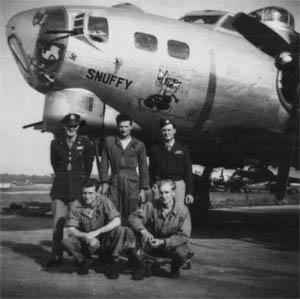
Rear L-R John Hanning (CP), M/Sgt. Arthur Kahn (Crew Chief), 2nd Lt. Charles G. Smith (P). Front L-R Ground Crew S/Sgt. Aldis Pollock, Cpl. Warren Palmgren. Photo courtesy of www.384thbombgroup.com
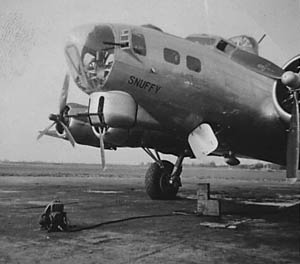
Snuffy pictured prior to the addition of the cartoon noseart. Photo courtesy of www.384thbombgroup.com
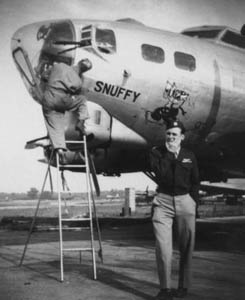
Snuffy now with nose art added. Photo courtesy of www.384thbombgroup.com
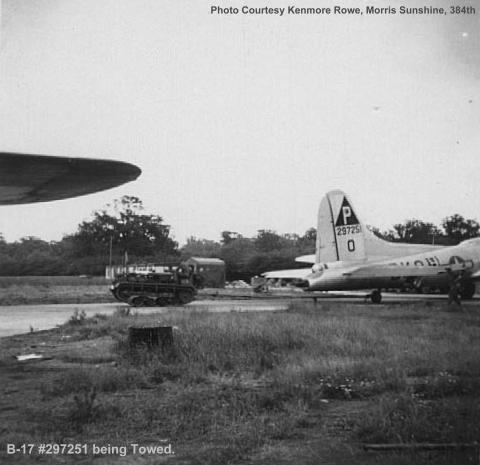
B-17G #42-97241 being towed across the airfield. Photo courtesy of www.384thbombgroup.com
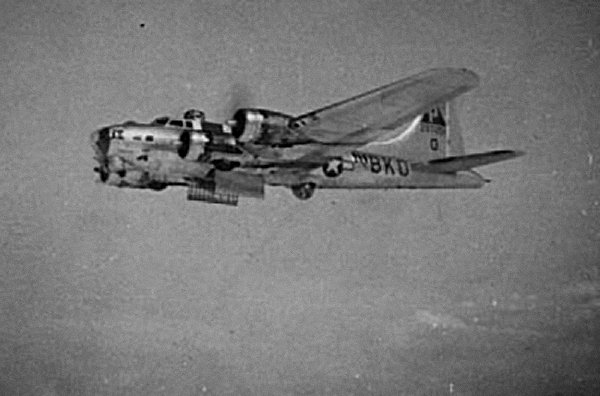
Snuffy pictured during a mission, with bomb bay doors open. Photo courtesy of www.384thbombgroup.com
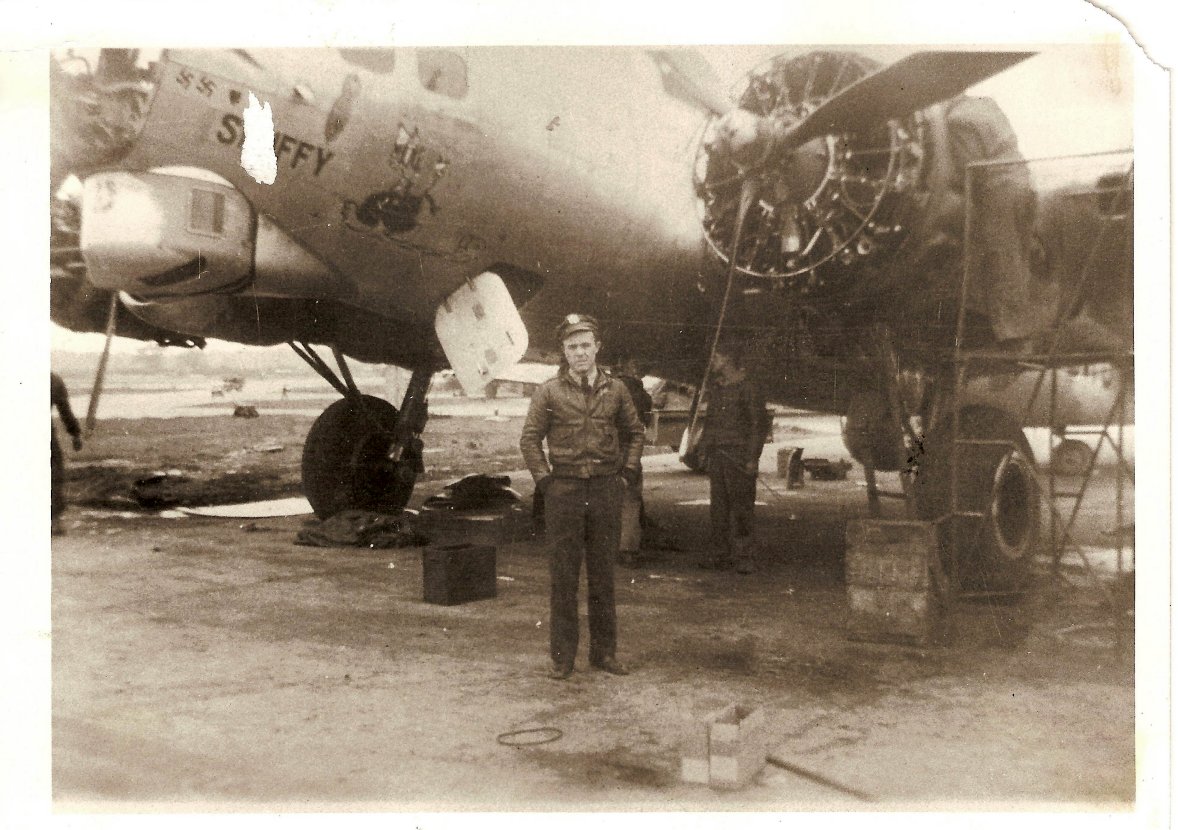
Snuffy undergoing engine maintenance. Note the two Swastika's painted on the nose, marking the apparent kill of two Luftwaffe aircraft. Phot The Quentin Bland Collection, courtesy of www.384thbombgroup.com
Snuffy
Last updated: June 30, 2026, 6:49 pm| Name: | Snuffy |
| Serial Number: | 42-97251 |
| Manufacturer: | Boeing Airplane Company |
| Finish: | Natural |
| Squadron: | 546th Bomb Squadron |
| Squadron ID: | BK-O |
| Combat Missions Credited: | 108 |
| Fate: | Crashed, destroyed 20/01/1945 |
Another product of the Boeing factory and Cheyenne, Wyoming, 42-97251 Snuffy joined the 546th Bomb Squadron on 24th March 1944 as a new replacement. It took its name from the popular hillbilly cartoon character “Snuffy Smith” from the comic strip “Barney Google and Snuffy Smith”.
Snuffy first flew in anger on 27th March 1944, participating on Mission #83, where a Luftwaffe airfield close to Tours and the city of Chartres (France) were both subject to bombs from the 384th. Assigned as 41 Squadron lead under the command of 2nd Lt. James Gilmore Miller II, Snuffy flew to the latter in clear weather, which apparently lead to accurate bombing. Assigned as a flying spare, the aircraft returned as planned on Mission #84, though on Mission #85, when flying to Brunswick to attack railway marshalling yards, it was unable to locate its formation in poor weather, leading to the impromptu return of it and the crew of 2nd Lt. Anthony Gekakis.
While participating on Mission #94 on 24th April 1944, a raid to strike the Dornier-Werke aircraft plant at Oberpfaffenhofen, Snuffy suffered considerable battle damage. 2nd Lt. Charles Grover Smith and his crew elected to land the aircraft away at Boxted, which was completed without further incident. The aircraft returned to service three days later, completing a brace of raids on 27th April 1944. The first of the two flights was Mission #96, where 2nd Lt. Charles Grover Smith once again commanded the aircraft, alongside some of the other crew who were also aboard for Mission #94. For Mission #96, the 384th flew as an independent group with no formation, targeting a V-Weapon service bunker near Sottevast, France. Despite hazy conditions, the target was struck. For Mission #97, under command of 2nd Lt. James Foster Everett of the 544th Squadron, Snuffy led the low squadron to attack Toul/Croix de Metz airfield (used by the Luftwaffe) near Nancy, France. Conditions were once again hazy, as they had been for Mission #96, but bombing was reported as “good”.
The following venture, Mission #98, while flying over Cromer to attack an industrial centre in Berlin, Snuffy and the crew of 2nd Lt. John Joseph Corcoran were forced to turn back to Grafton Underwood at 09.15 hours, due to fumes inside the aircraft and gas leaking from the starboard wing, thereby aborting the operation.
42-97251 flew on the group’s second mission on 6th June 1944 (D-Day), acting as M Squadron deputy while attacking two bridges in Caen (France), with the intention of condensing the German forces trying to combat the Allied forces landing on the beaches at Normandy. Ten days later, while crewed by 2nd Lt. James Allen Gibson and his contingent, the aircraft was forced to abort on Mission #137, owing to its inability to locate the formation it was supposed to assemble in, over England. Later in the month, after bombing a Luftwaffe airfield near Juvincourt (France) on Mission #148, Snuffy, under the command of 2nd Lt. James Edward Rosborough, was forced to land at RAF Wattisham due to bad weather at Grafton Underwood.
Come July, 42-97251 was forced to abort two missions in the space of a week. On 7th July 1944, during Mission #153 and once again manned by the crew of 2nd Lt. Rosborough, the aircraft was forced to turn back to Grafton Underwood for “unknown reasons” instead of striking a Me-109 plant in Leipzig. Although Snuffy’s reason for returning is not confirmed, the mission report states that heavy cloud caused the formation of B-17's to deteriorate, and that many of the 384th Bomb Group's aircraft could not locate the formation again. Snuffy was scrubbed from Mission #155, replaced by 2nd Lt. Rosborough’s crew aboard fellow century bomber The Challenger on 11th July 1944. This was the last time Snuffy would cross paths with them, for on the following day, during Mission #156, they were killed or incarcerated as Prisoners of War when their B-17 Aces & Ates crashed after sustaining FLAK damage.
13th July 1944 saw Snuffy encounter difficulty while flying during Mission #157. During assembly, the oxygen hose in the ball turret broke, which not only affected Sgt. Harold Omas Price (in the ball turret), but also S/Sgt. Howard Glen Norton in the waist gunner position. As a result, the pilot (2nd Lt. Marion Endelicato) elected to abort the mission on the railway marshalling yards in Munich. A month later, on 13th August, the aircraft returned from Mission #179 with engine #1 feathered, though it had successfully struck transportation infrastructure in the Beaumont-le-Roger region of France. The crew aboard, that of 2nd Lt. Edward Banks Tracy, returned with no injuries.
During Mission #202, the aircraft failed to drop its load on Munster due to the bomb doors malfunctioning. Though the crew aboard (that of 2nd Lt. Edward Chmura) managed to hand crank the doors open, Snuffy had flown across the bomb line, and was therefore unable to contribute to the carnage.
Snuffy would be forced to land away from Grafton Underwood twice more during its service. Once on Mission 226 on 16th November 1944, where 2nd Lt. Francis Frederick Cepits was forced to land at Stratford due to poor weather after attacking tactical artillery positions in Eschweiler (Germany). The next occasion was on 18th December 1944, while returning from Mission #240, having bombed a road junction in Germünd, Germany, where 2nd Lt. Brian Dunn Rummel Jr. guided the aircraft to Chievres (Belgium) due to low fuel, before returning to Grafton Underwood the next day.
Mission #257 on 20th January 1945 would, however, be Snuffy’s 108th and last. Having successfully bombed road and rail bridges in Mannheim (Germany), heavy snow storms at an altitude of approximately 800ft prevented the aircraft landing at Grafton Underwood. Therefore, the group leader diverted elsewhere at airfields with more accommodating weather. During this time, the pilot of Snuffy, 2nd Lt. Raymond D. Cook, suggested that his visibility was negligible, and decided to change their heading in order to prevent a mid-air collision. Both 2nd Lt. Cook and his co-pilot, 2nd Lt. Philip Neldon Leavitt reported icing on the wings and propellors. As a result, Snuffy began to lose airspeed and altitude, with 2nd Lt. Cook ordering preparations for the crew to bail out at approximately 4,000ft, before the crew eventually did at 2,500ft. Prior to jumping, 2nd Lt. Leavitt noted that the airspeed had dropped to 80mph, and that the #3 propeller had run away. Despite the throttles being set to full power, he noted in his diary that Snuffy was still losing 1,000ft per minute.
Though he states otherwise in his official statement, 2nd Lt. Leavitt also confides to his diary that there was struggle opening the escape hatch. The reason that this discrepancy is important is because he uses it as a justification to say that the airspeed was low at the time of abandoning the aircraft. After 2nd Lt. Cook had determined he could do no more for the aircraft, he too bailed out at approximately 16.00 hours. Both pilots stated that all crew landed within a square mile of each other, and that only 2 crew (tail gunner Corporal Howard Clarence “Krup” Krupsky and waist gunner Sergeant Forest Raymond “Barrel” Green) suffered minor injuries, reportedly broken ankles. Both pilots recorded crashing near Kibworth or Tur Langton, Leicestershire, while the sortie report suggested Snuffy and the crew came down 2.25 miles northwest of Old Weston (near RAF Molesworth), a significant difference. In the aftermath, 2nd Lt. Leavitt writes of taking Corporal Krupsky to a house in a nearby village, and being accommodated by a Mrs Cramp, whom he describes as offering a “typically English” hospitality, before returning to Grafton Underwood by truck. As 2nd Lt. Leavitt wrote, it was a “lucky day” aboard the “old lemon 251, Snuffy”.
The official report of the incident did not see weather as the cause of the crash, however. Instead, the board found 2nd Lt. Cook 100% at fault for the incident, citing that he was not “confident to fly his aircraft” in the conditions, and lacked experience and knowledge of the fundamentals of instrument flying. This conclusion, they wrote, was “further substantiated by the fact that none of the other aircraft that day, with the possible exception of one, had reported having any undue amount of trouble in handling their aircraft”. This, the board believed, was a greater factor than weather, stating that only “3/4 inches” of ice accumulated on the leading edge of the wing.
Research courtesy of Charlie Saddington on behalf of 384th Bombardment Group Museum.
With kind thanks to the 384th Bomb Group website www.384thbombgroup.com for permission in using material from their records in the making of this story. It holds a wealth of information, documents and photographs of their activities during World War 2.
Further information courtesy of www.newspapers.com, www.ancestory.com and www.findagrave.com
Gallery
Rear L-R John Hanning (CP), M/Sgt. Arthur Kahn (Crew Chief), 2nd Lt. Charles G. Smith (P). Front L-R Ground Crew S/Sgt. Aldis Pollock, Cpl. Warren Palmgren. Photo courtesy of www.384thbombgroup.com
Snuffy pictured prior to the addition of the cartoon noseart. Photo courtesy of www.384thbombgroup.com
Snuffy now with nose art added. Photo courtesy of www.384thbombgroup.com
B-17G #42-97241 being towed across the airfield. Photo courtesy of www.384thbombgroup.com
Snuffy pictured during a mission, with bomb bay doors open. Photo courtesy of www.384thbombgroup.com
Snuffy undergoing engine maintenance. Note the two Swastika's painted on the nose, marking the apparent kill of two Luftwaffe aircraft. Phot The Quentin Bland Collection, courtesy of www.384thbombgroup.com