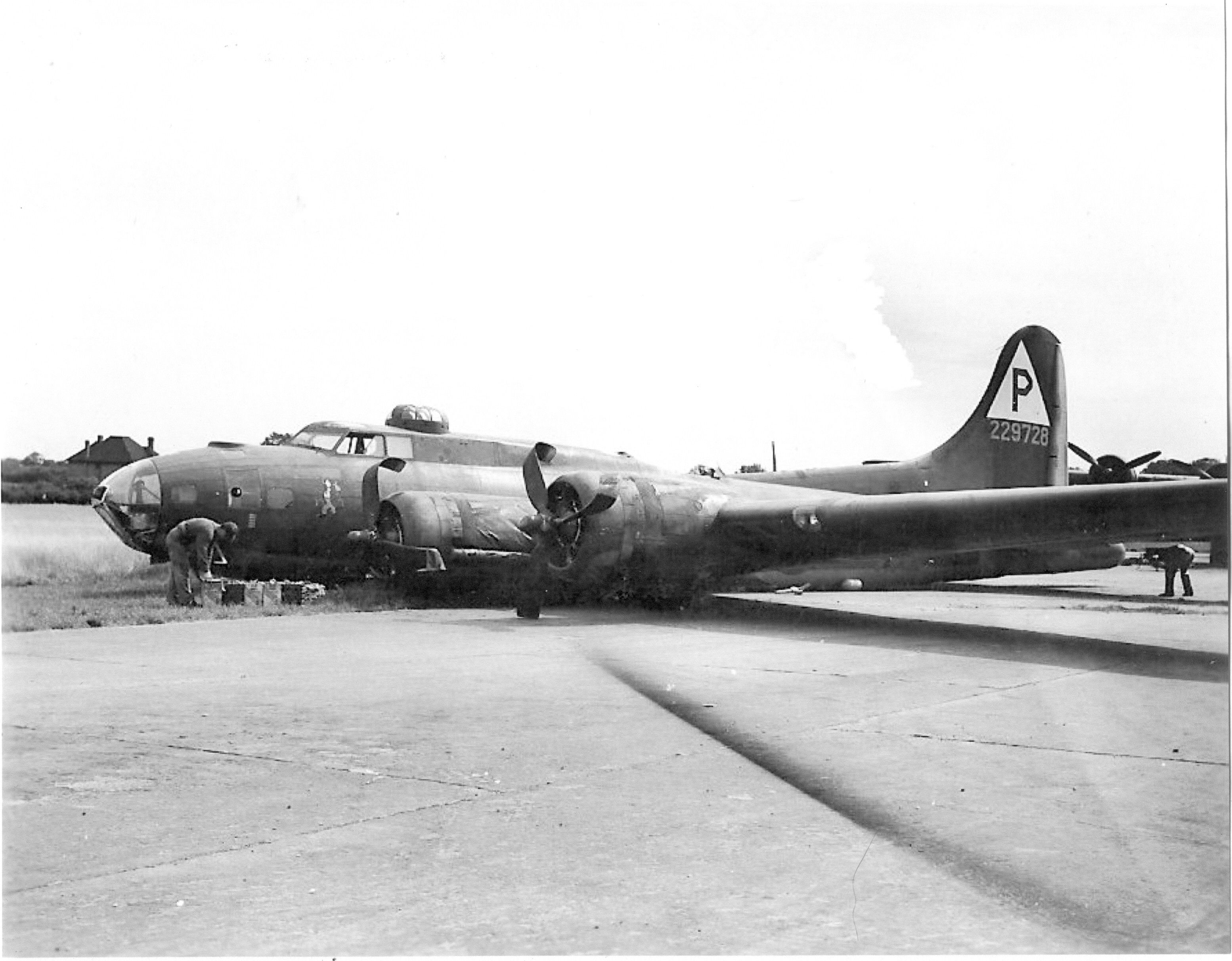
B-17F #42-29728 after crash landing at RAF Grafton Underwood, 17th August 1943. Photo courtesy of www.384thbombgroup.com
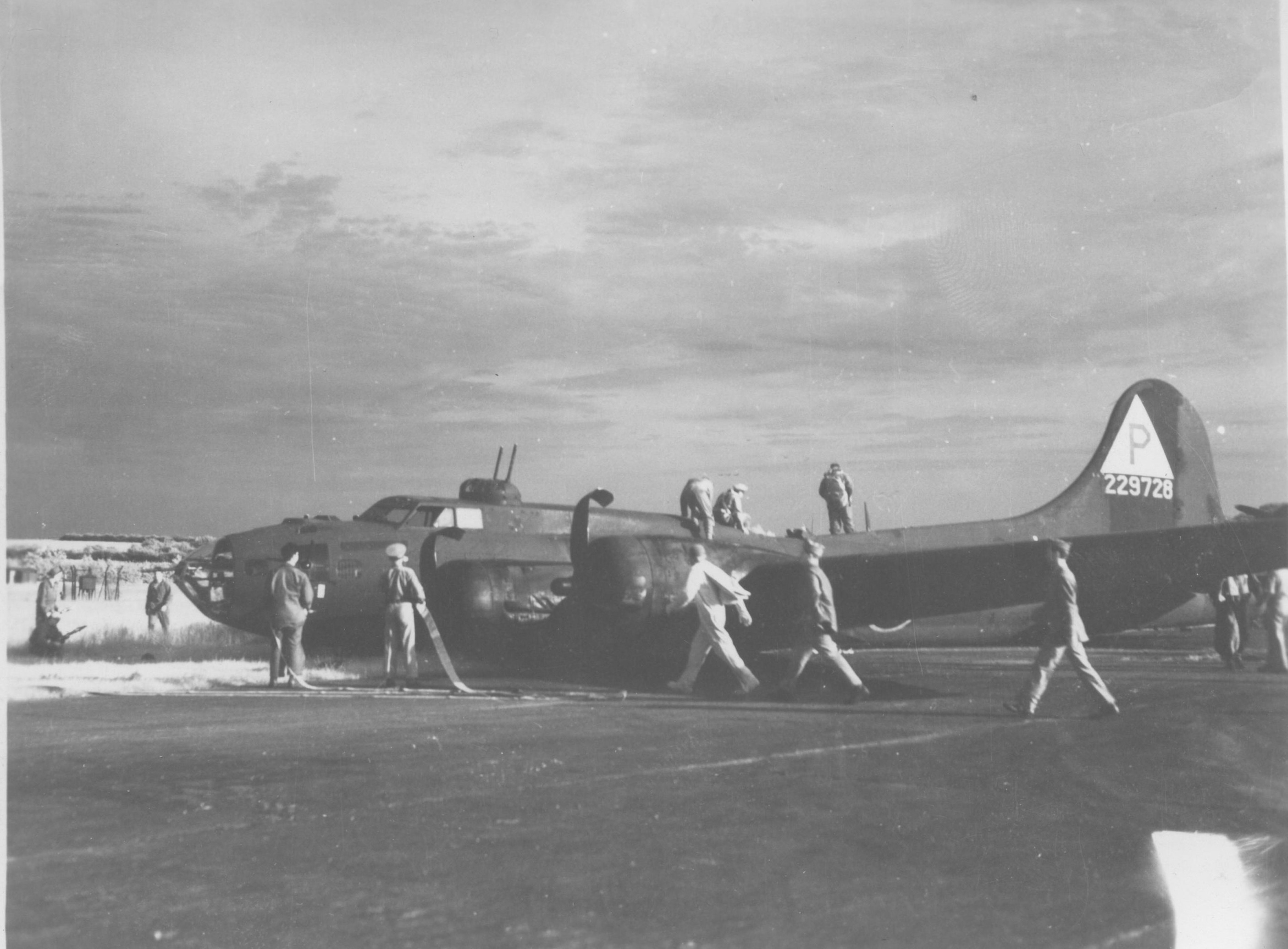
Damage to one of the aircraft's undercarriage legs prevented it from fully extending. It was decided by the crew the safest option was to belly land the aircraft. Photo courtesy of www.384thbombgroup.com
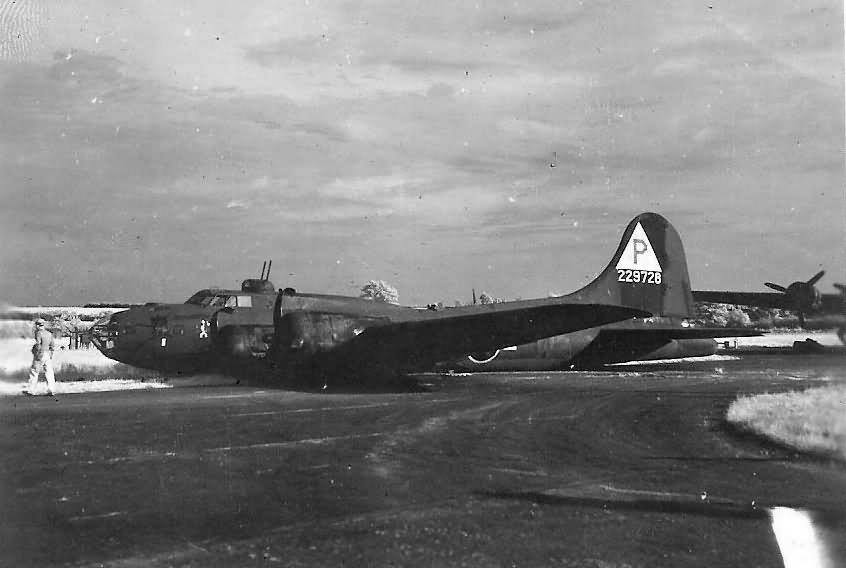
The aircaft slid along almost the entire length of Runway 2, becuase sliding to a stop at the southern end of the runway, narrowly missing a parked B-17. Photo courtesy of www.384thbombgroup.com
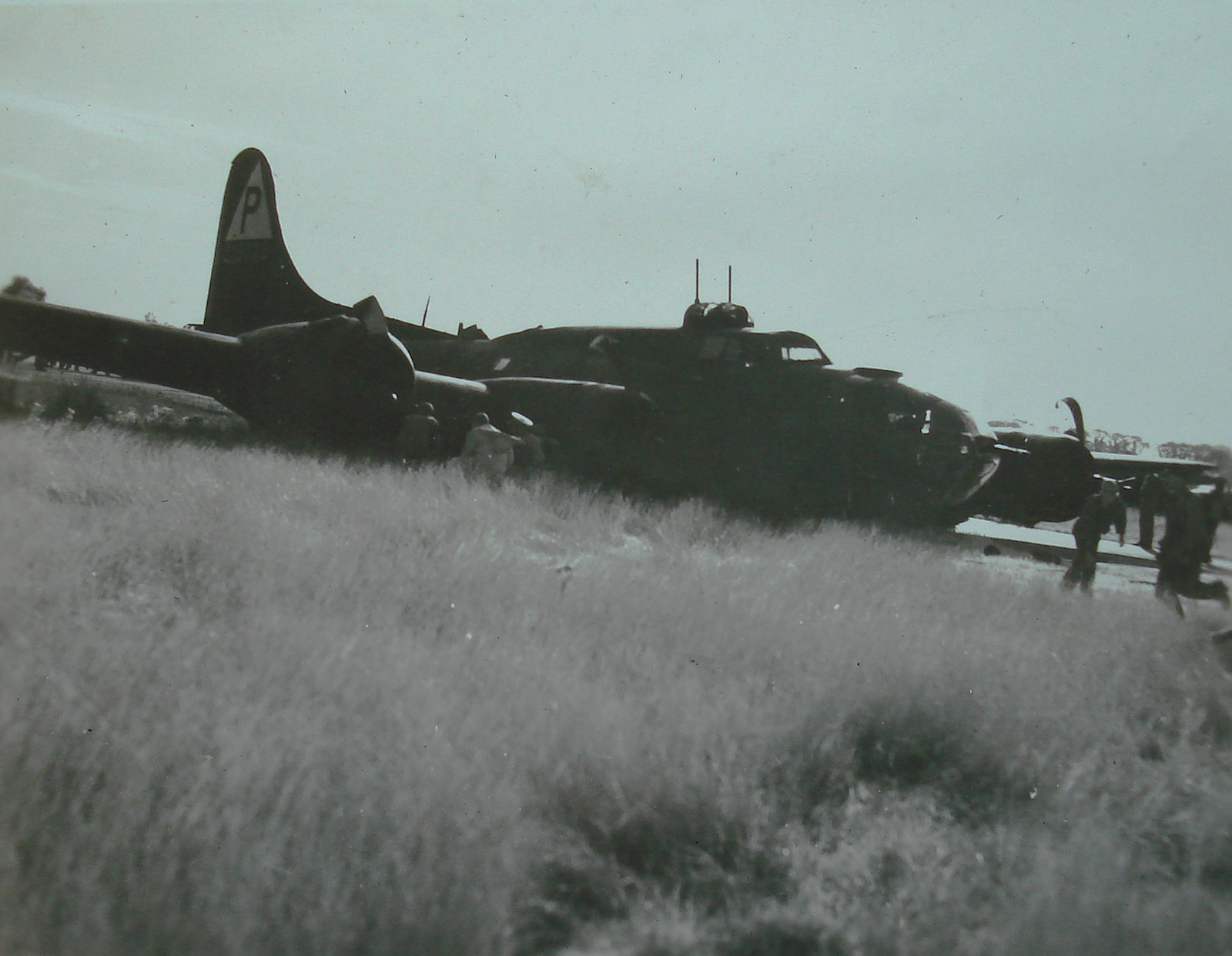
Damage to the airframe from the crash, and also what had been sustained from the mission, meant the aircraft was written off after being recovered. Photo courtesy of www.384thbombgroup.com
El Rauncho
Last updated: March 6, 2026, 8:37 pm| Name: | El Rauncho |
| Serial Number: | 42-29728 |
| Manufacturer: | Boeing Airplane Company |
| Finish: | Camouflage |
| Squadron: | 544th Bomb Squadron |
| Squadron ID: | SU-J |
| Combat Missions Credited: | 3 |
| Fate: | Crash landed, RAF Grafton Underwood |
Delivered at Cheyenne, Wyoming Modification Centre on 9th February 1943, B-17F #42-29728 was originally assigned to the 332nd Bomb Squadron, 9th Bombardment Group based at RAF Bassingbourn on 20th April 1943.
On the 12th July 1943 the aircraft was transferred across to the 384th Bombardment Group, being assigned to the roster of aircraft of the 544th Bomb Squadron, being named El Rauncho.
The first scheduled mission for #42-29728 was on the 24th July - the aircraft was not able to participate, and was replaced on the mission by a spare. The 25th July was a repeat - again El Rauncho was on the roster of aircraft to participate on the days' mission, but again was replaced by a spare aircraft. The next days mission on 26th July was scrubbed, with the aircraft again on the roster of aircraft to take part.
Finally, on the 28th July, El Rauncho was to participate in its first combat mission for the 384th, on a mission to Kassel, Germany. After the formation had crossed into Germany, the 303rd Bomb Group element was forced to withdraw, leaving 26 aircraft from the 384th Bomb Group. This was below the minimum allowed to complete the mission, so the remaining aircraft were forced to turn around and head back to base. An attacking force of enemy fighter aircraft to make attacks against the retreating force, with the formation eventually jettisoning the majority of its bomb load into the North Sea, to avoid landing back at base with a full bomb load.
El Rauncho's next mission was now not until the 15th August, with it's next mission coming two days later on the 17th August - the infamous first Schweinfurt raid.
The crew on this mission weren't normally associated with this aircraft - their usual B-17, Stella, was unserviceable, partly due to damage caused to one of its horizontal stabilisers by an over-zealous gunner. The aircraft had found itself located in the Low Group of the Low Squadron, a spot otherwise known as 'Coffin Corner' due to its exposed location within the formation. The mission proved to be extremely challenging for the crew of El Rauncho, with a running battle of over four hours being fought against enemy fighters and flak. The top turret had failed, it being unable to rotate, leaving the guns fixed in a forward position. An oxygen leak had occurred to the ball turret. The tail had been damaged, and some flying surfaces had suffered damage. Damage had occurred to one of the undercarriage legs, with a piece of flak being left wedged in the tyre. One propellor had been feathered. It was later reported that over 300 separate holes had been made across the airframe.
Nonetheless, the aircraft eventually made its way back to Grafton Underwood, where an issue was soon discovered that would have serious consequences. One landing gear strut would only extend around half way down, meaning it would collapse upon landing, which would pivot the aircraft rapidly around the good strut. Multiple attempts were mad to raise and then lower the gear, but to no avail. The safest course of action would be to perform a belly landing.
The crew intended to circle the field at around 1,500 feet waiting for the other aircraft to land, before they would come in, potentially causing a hazard on the ground. Their course of action was suddenly forced, as another engine quite due to a lack of fuel - there was no time to delay, with Runway 2 being the easiest runway to chose given their position. The aircraft landed, sliding for much of the length of the runway in a shower of sparks, before finally sliding to a halt near the end of the runway, in the area of dispersals 32-34, narrowly missing a parked B-17.
As soon as the aircraft came to a stop, the crew evacuated and distanced themselves from the aircraft as there was a very real risk of explosion. Other than minor shock, there was no lasting injury to any of the crew.
Crew of El Rauncho on 17th August 1943
Pilot Randolph George Edward Jacobs
Co-Pilot Eugene Arthur Boger
Navigator John Quinn Curtin
Bombardier James Edward Siebel
Radio Operator Doy Jennings Cloud
Engineer / Top Turret Aldo Joseph Gregori
(384th Bombardment Group Museum - The people of the 384th - Aldo Joseph Gregori)
Ball Turret Thomas Joseph Vezina
Tail Gunner Robert Lewis Compton
Waist Gunner Jack Keith Goetz
Waist Gunner Lawrence Holmes Wager
With kind thanks to the 384th Bomb Group Heritage Association website (384thbombgroup.com) for permission in using material from their records in the making of this story. It holds a wealth of information, documents and photographs of the Group’s activities during World War 2.
Research courtesy of Keith Andrews on behalf of 384th Bombardment Group Museum.
Gallery
B-17F #42-29728 after crash landing at RAF Grafton Underwood, 17th August 1943. Photo courtesy of www.384thbombgroup.com
Damage to one of the aircraft's undercarriage legs prevented it from fully extending. It was decided by the crew the safest option was to belly land the aircraft. Photo courtesy of www.384thbombgroup.com
The aircaft slid along almost the entire length of Runway 2, becuase sliding to a stop at the southern end of the runway, narrowly missing a parked B-17. Photo courtesy of www.384thbombgroup.com
Damage to the airframe from the crash, and also what had been sustained from the mission, meant the aircraft was written off after being recovered. Photo courtesy of www.384thbombgroup.com