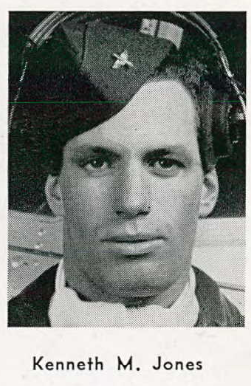
2nd Lt. Kenneth Myron Jones. MIA 8th My 1944. Photo Find A Grave, courtesy of www.384thbombgroup.com
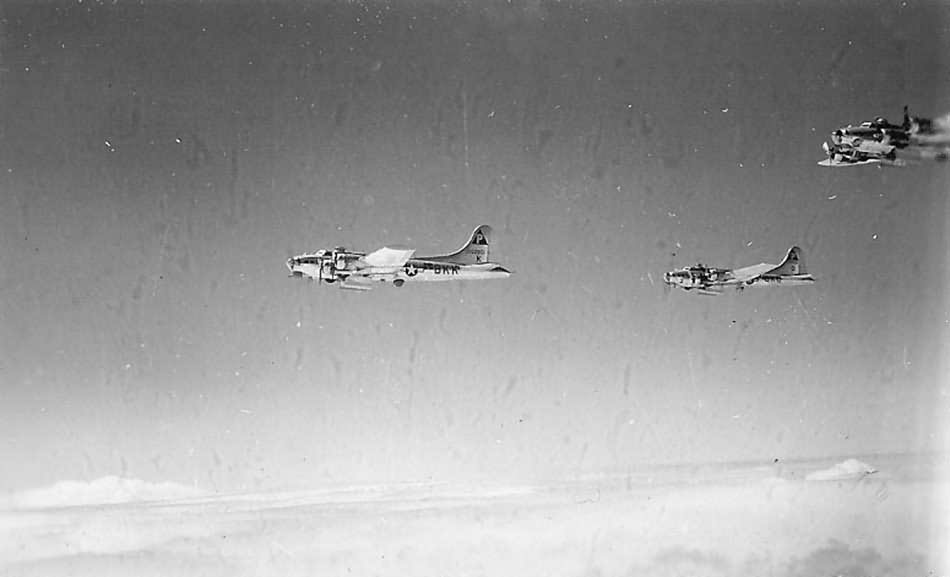
B-17G #42-97081 (BK-K), centre of image - the aircraft that 2nd Lt. Jones was lost on. Photo courtesy of www.384thbombgroup.com
The Story of Kenneth Myron Jones
Last updated: January 4, 2026, 4:12 pm2nd Lt.
Kenneth Myron Jones
Navigator
547th Bomb Squadron
384th Bombardment Group (Heavy)
Serial Nr. O-699180
Awarded Purple Heart and Air Medal
MIA 08/05/1944 Aged 26
Combat Missions Credited - 3
Resting place - Tablets of the Missing, Cambridge American Cemetery, Madingley, Cambridge, UK
Kenneth Myron Jones was born on 19th June 1917, in Michigan City, La Porte County, Indiana. His parents were James F. Jones and Addie M. Jones, Kenneth also had a sister Mary.
On the 16th April 1944 2nd Lt. Kenneth M. Jones was assigned to the 547th Bomb Squadron. His first mission was to come on 4th May 1944 when the group's target for the day was the Friedrichstrasse Railroad Station in Berlin, Germany. Three days later, on the 7th May 1944, he was to fly his second mission, again to the same target in Berlin.
2nd Lt. Jones' third mission was on 8th May 1944, mission #103 for the 384th Bomb Group. Today was a Crossbow Mission, the code name for missions targeting the growing menace of the V-weapons. They would be targeting the V-2 bunkers, still under construction, at Sottevast, France. On this day the 384th actually flew two missions - the Sottevast raid was the second, departing Grafton Underwood at 16.00, with 19 aircraft assigned. The aircraft that 2nd Lt. Jones was assigned to was B-17G #42-97081, an unnamed aircraft flying its 17th combat mission.
Onboard the aircraft, tail gunner S/Sgt. G.H. Yaeger and Bombardier 2nd Lt. Carl William Kuba, were both to record an accurate account of the mission that details clearly the incidents leading to the ultimate loss of the aircraft over the English Channel.
Immediately after starting the bomb run the aircraft suffered flak hits on the #4 and #1 engines, with both engines shutting down. A second flak hit in the area of the tailwheel severed the wheel, and it fell away from the aircraft. A further hit struck the left wing, causing considerable damage and leaving only a small portion undamaged and holding the wing to the airframe. Damage had also occurred to the main oxygen system onboard the aircraft, meaning there was now no oxygen supply from the aircraft to the crew. With a fire starting in the #4 engine, it was feared the aircraft was at the point of being lost so the aircraft slipped out of the formation, with the crew starting to prepare to bale out. However, shortly this fire was to extinguish itself and having re-assessed the situation, it was now felt there was a chance of making it back across the English Channel to England. To ease the oxygen situation onboard, the aircraft descended to 13,000 feet.
Shortly afterwards, a fire started in the left wing as a result of the flak hit. With the wing already severely damaged, the situation was now hopeless - with no intercom, the bale out bell was activated by the pilot and the crew began to bale out of the aircraft, around 15 miles across the Channel from the French coast at Cherbourg.
The bombardier, 2nd Lt. Kuba, states he was the eighth crew member to leave the stricken aircraft, immediately after 2nd. Lt. Kenneth M. Jones had baled out. Kuba also states that he purposely delayed pulling the ripcord to deploy his parachute once clear of the aircraft as his concern was the crew would become spread out in the waters below. He noted that around 10-15 B-17s had circled their position, as well as some Spitfires. One of the Spitfires dropped a dinghy, however, this landed 400-500 yards from him, and he was unable to reach it. The time was just after 19.00. Their B-17 had now descended to around 500 feet, when suddenly an explosion brought it crashing into the sea, with the wreckage eventually sinking about five minutes later.
Of the crew of ten, just three were recovered, with the pilot and co-pilot never leaving the aircraft. S/Sgt. Yaeger, 2nd Lt. Kuba and S/Sgt. Donald Edward Reis (flexi gunner) had all been able to keep swimming for around 90 minutes, until they were eventually rescued by an air-sea rescue unit. Unfortunately, S/Sgt. Reis was to die of exposure shortly afterwards.
The body of 2nd Lt. Kenneth Myron Jones was never recovered. Today, he is remembered on the Tablets of the Missing, at the American Cemetery at Cambridge, England. His name is recorded alongside the other 6 members of his crew who are today, still recorded as Missing in Action.
For his actions, 2nd Lt. Kenneth Myron Jones was awarded the Purple Heart medal, alongside the Air Medal.
Research courtesy of Keith Andrews on behalf of 384th Bombardment Group Museum.
With kind thanks to the 384th Bomb Group website www.384thbombgroup.com for permission in using material from their records in the making of this story. It holds a wealth of information, documents and photographs of their activities during World War 2.
Further information courtesy of www.newspapers.com, and www.findagrave.com
Gallery
2nd Lt. Kenneth Myron Jones. MIA 8th My 1944. Photo Find A Grave, courtesy of www.384thbombgroup.com
B-17G #42-97081 (BK-K), centre of image - the aircraft that 2nd Lt. Jones was lost on. Photo courtesy of www.384thbombgroup.com